Django-Bolt
Django-Bolt is a high-performance API framework for Django. It lets you build APIs using familiar Django patterns while leveraging Rust for speed.
Installation
Install using pip:
Or with uv:
At a glance
Here's a simple API endpoint:
from django_bolt import BoltAPI

api = BoltAPI()

@api.get("/", summary="My first api endpoint 🤗")
async def hello():
    return {"message": "Hello, World!"}
Add django_bolt to your INSTALLED_APPS in settings.py:
Run it with:
That's it. You now have an API endpoint at http://localhost:8000.
You also get automatic API documentation at http://localhost:8000/docs:
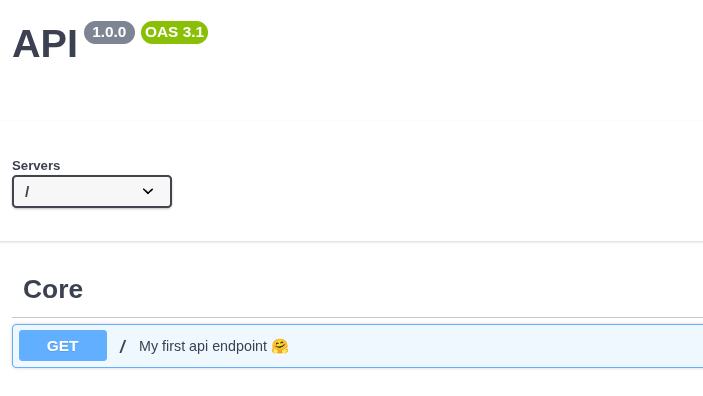
Other documentation UIs are also available by default: Redoc (/docs/redoc), Scalar (/docs/scalar), RapiDoc (/docs/rapidoc), and Stoplight Elements (/docs/stoplight). See the OpenAPI documentation for customization options.
Why Django-Bolt?
Django-Bolt is designed for developers who:
- Already know Django and want to build APIs quickly
- Need high performance without leaving Python
- Want type-safe request handling with automatic validation
- Prefer async/await for I/O-bound operations
Key features
Simple routing - Decorator-based routing similar to FastAPI, Litestar and Flask:
Automatic validation - Request data is validated using Python type hints:
import msgspec

class CreateUser(msgspec.Struct):
    username: str
    email: str

@api.post("/users")
async def create_user(user: CreateUser):
    return {"username": user.username}
Django integration - Works with your existing Django models and ORM:
from myapp.models import User

@api.get("/users")
async def list_users():
    users = await User.objects.all().acount()
    return {"count": users}
Built-in authentication - JWT and API key authentication out of the box:
from django_bolt.auth import JWTAuthentication, IsAuthenticated

@api.get("/profile", auth=[JWTAuthentication()], guards=[IsAuthenticated()])
async def profile(request):
    return {"user_id": request.user.id}
Next steps
- Quick Start - Build your first API
- Deployment - Deploy with multiple processes
Getting help
- Check the topic guides for in-depth explanations
- Look at the API reference for detailed information
- Report issues on GitHub